
June 16, 2026
What Is a Universal Candidate Profile?
Key Takeaways
- A universal candidate profile lets a job seeker enter their information once and reuse it across every employer on the same platform.
- Over 80% of job seekers browse career sites on mobile, where friction drives drop-off. Most career sites convert less than 5% of visitors into any action.
- Universal candidate profiles capture high-intent, direct-traffic visitors before they are ready to apply, then re-engage them automatically so return visits convert at a higher rate.
- A universal candidate profile also protects against bot applications by verifying candidate identity through phone number authentication and tracking engagement patterns across multiple employers.
Why do career sites lose most of their high-intent visitors?
For years, talent acquisition teams have pulled one lever to drive more applicants: spend more on job boards, programmatic advertising, or career site traffic. More budget, more applications.
It works. Until it doesn't.
Most career sites are already sitting on a pool of high-intent visitors every day. They're losing the vast majority of them before they ever connect. Two shifts explain why.
Job search moved to mobile. Over 80% of job seekers use a mobile device during their job search, according to Glassdoor's State of Mobile Job Search (the survey puts it closer to 9 in 10). They move quickly, compare options, and expect the same frictionless experience they get from every other consumer app. When the barrier is too high, they leave. Even when they're interested.
Application volume exploded. AI-generated submissions from job boards have pushed application volume to levels recruiters have never seen before. TA teams are overwhelmed with applicants they didn't want, while the candidates they did want — the ones who came directly to their career site — slip away before connecting.
A universal candidate profile addresses both sides of that problem.
What is a universal candidate profile?
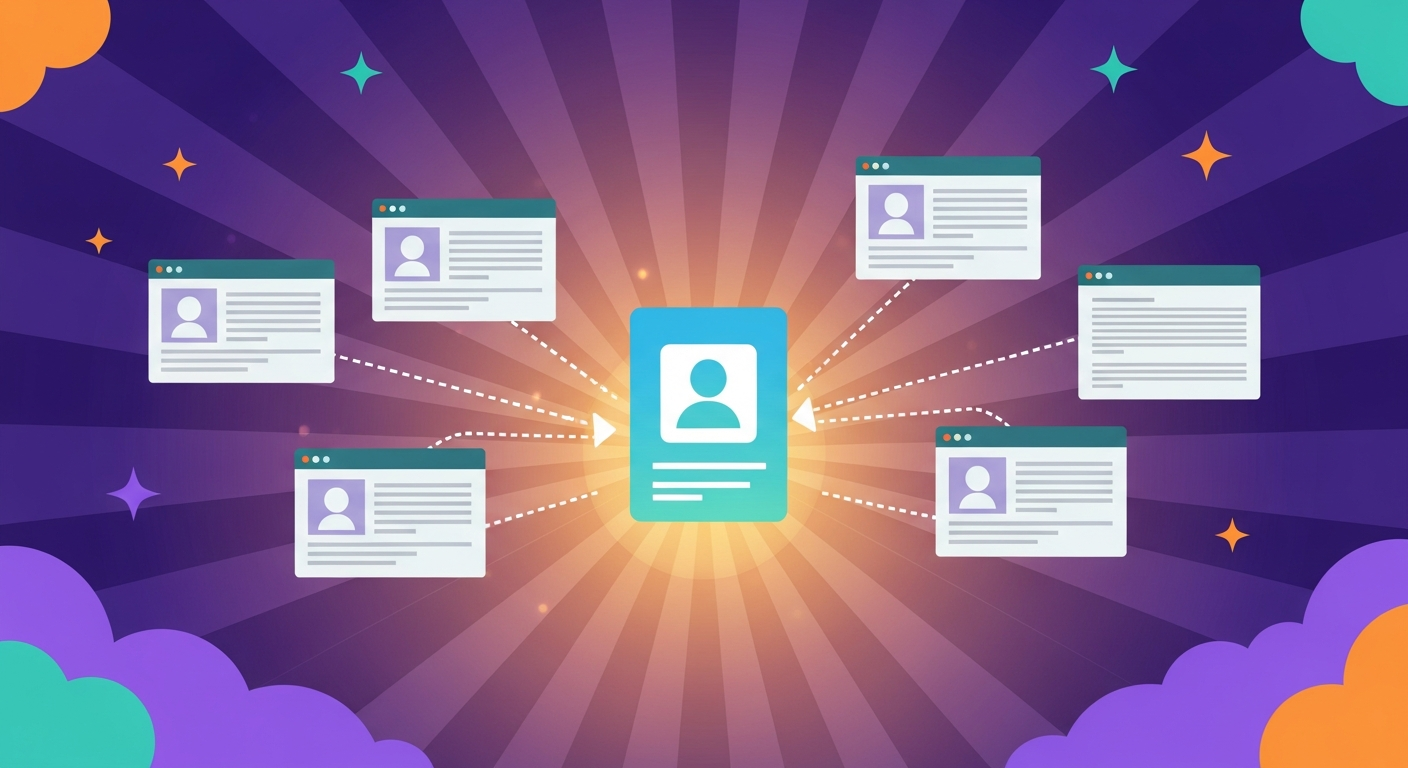
A universal candidate profile is a portable data layer that lets job seekers enter their information once and reuse it instantly across any employer on the same platform.
Here's how it works. Multiple employers adopt the same underlying technology provider. When a candidate connects for the first time on any participating career site, they create a profile: contact information, job preferences, and any role-specific screening responses. The next time that candidate visits any other employer on that platform — whether it's the same company or a completely different one — their information is already there. They connect in a few clicks.
This matters as much for candidates as it does for employers. Job seekers apply to multiple roles across multiple companies. Every time they're asked to re-enter the same information, it signals that the system wasn't built with them in mind. Friction erodes interest. Candidates who were genuinely considering a role abandon the process, not because they changed their mind, but because the experience asked too much of them.
A universal candidate profile removes that barrier. The candidate's data belongs to them and travels with them across every employer on the platform. Every connection becomes faster than the last.
Think of it as Shop Pay for job seeking. Consumers don't re-enter their payment and shipping details every time they check out on a Shopify store. They sign in and go. A universal candidate profile brings that same experience to employer career sites — and it meets an expectation job seekers already have from every other consumer app they use.
And here's where it gets interesting: the profile gets richer over time. Every time a candidate connects with another employer on the platform and shares additional data — whether that's updated job preferences, new screening answers, or fresh location details — that information layers onto their profile. The more employers they engage with, the more complete the picture becomes.
That richness feeds directly into matching. A candidate who has connected with three employers and shared detailed preferences across multiple roles gives the platform far more signal than someone who filled out a single form once. More data means better matching. Better matching means higher-quality candidate-to-job fit. And higher quality means better conversion for employers and better outcomes for candidates. The flywheel compounds: every connection makes the next one smarter.
How does a universal candidate profile work?
Three steps.
- Create once. On a first visit to any career site on the platform, the candidate enters their contact information, job preferences, and any role-specific screening answers.
- Reuse everywhere. On any later visit to any employer on that same platform, their information is already populated. They connect in a few clicks.
- Get recognized on return. Because the profile travels with the candidate across all participating employers, returning visitors are recognized instantly and convert at a higher rate than first-time visitors.
What does a universal candidate profile mean for employers?
For TA leaders, the impact shows up in one place: conversion.
Career sites consistently convert less than 5% of visitors into any action at all. Industry benchmarks put the average at roughly 2 to 5%. Yet the candidates who visit directly are already your most valuable audience. They came to you. They're researching your brand and your roles. And they're 3x more likely to be hired than applicants from job boards.
Without a low-friction way to connect before they're ready to apply, most of them leave without a trace.
A universal candidate profile changes that equation. When integrated into a career site, it lets employers:
- Capture high-intent visitors earlier in their journey, before they're ready to apply
- Stay connected with those candidates until they are ready
- Convert return visits at a meaningfully higher rate, because returning candidates are recognized
The employers seeing the biggest gains from their career sites aren't the ones spending more on advertising. They're the ones making it easier to connect and building systems that remember their highest-intent job seekers.
How does a universal candidate profile protect against bot applications?
One unexpected benefit of a universal candidate profile: it makes bot applications significantly harder.
Phone number verification. Most universal candidate profile systems authenticate candidates through SMS verification, not just email. Bots can generate fake email addresses at scale. Phone numbers — especially US mobile numbers — are harder to acquire and easier to detect when fake.
Cross-employer behavioral patterns. Because the profile travels across multiple employers on the same platform, the system can track engagement patterns over time. Real candidates browse jobs, click on alerts, and apply over weeks. Bots submit applications in bulk with no prior engagement. A candidate who has interacted with jobs at multiple employers over several weeks is almost certainly a real person.
Interest scoring. Many implementations include engagement-based scoring. Did the candidate click job alerts? Did they return to the site? Did they spend time reading job descriptions? Bots don't generate those behavioral signals. Real candidates do.
Human-in-the-loop triggers. If a candidate profile shows suspicious patterns, red flags show up before the application is even completed. Extremely fast form completion, identical screening answers across dozens of jobs, or zero engagement with job content can all trigger manual review.
The result: career sites using universal candidate profiles see far fewer fake applications compared to traditional open-form career sites where anyone can submit an application without prior connection or verification.
Universal candidate profile vs. a traditional job application
| Traditional application | Universal candidate profile | |
|---|---|---|
| Data entry | Re-entered on every site | Entered once, reused everywhere |
| Effort to connect | Long form, high friction | A few clicks |
| Timing | Apply only when ready | Connect before ready to apply |
| Return visits | Treated as a new visitor | Recognized and pre-filled |
| Data ownership | Lives in each employer's system | Belongs to and travels with the candidate |
| Bot protection | Minimal (email verification only) | Phone verification + behavioral tracking |
How does Dalia use universal candidate profiles?
Dalia operates a platform with more than 10 million candidates. Here's how it works:
- A candidate visits your career site. They browse jobs, research your culture, and show intent — but aren't yet ready to apply.
- Dalia invites them to connect. If they're one of the 10 million-plus candidates already in the Dalia platform, their profile is pulled forward automatically. They sign in with a phone number, confirm via short code, and connect in seconds.
- Re-engagement is automatic. Candidates receive personalized job matches by SMS and email, built around their role interests and location. This is matched re-engagement based on actual preferences, not a generic nurture drip.
- Completed applications reach your ATS. Fully completed applications are delivered straight into your applicant tracking system.
Frequently Asked Questions
What is a universal candidate profile?
A universal candidate profile is a portable data layer that lets job seekers enter their information once and reuse it across any employer on the same platform. They connect in a few clicks instead of re-entering details on every career site.
How is a universal candidate profile different from a traditional job application?
A traditional application asks candidates to re-enter their information on every site and only captures them once they're ready to apply. A universal candidate profile stores that information once, reuses it everywhere on the same platform, and lets candidates connect before they're ready to formally apply.
Do candidates have to create a new profile for each employer?
No. The profile is created once and reused across every employer on the same platform. On return visits, the candidate's information is already there, and they connect in a few clicks.
How much can a universal candidate profile improve career site conversion?
Most career sites convert less than 5% of visitors into any action. By removing entry friction and recognizing returning candidates, a universal candidate profile can at least double conversion to completed application for both new and returning visitors.
How does a universal candidate profile prevent bot applications?
By requiring phone number verification, tracking cross-employer engagement patterns across the platform, and flagging suspicious behavior like no prior job browsing, instant form completion, or identical screening answers. Real candidates generate behavioral signals over time. Bots don't.
Where is a universal candidate profile used?
A universal candidate profile is integrated into employer career sites, allowing job seekers to connect with minimal friction before or during the application process.
What is the Dalia platform?
Dalia operates a platform with more than 10 million candidates who have created profiles. When a candidate in the platform visits any Dalia employer's career site, their information is pre-filled and they can connect in a few clicks.
The Bottom Line
The career site is already your highest-quality source of applicants. Career site applicants are 3x more likely to be hired than job board applicants. Yet most career sites convert less than 5% of visitors into any action and have limited ways to capture, remember, or re-engage the ones who leave.
A universal candidate profile closes that gap. When candidates can connect in a few clicks, skip re-entry on return visits, and receive job alerts matched to their actual interests, conversion rises for new and returning visitors alike. And because the platform verifies identity and tracks engagement, the applications you receive are far less likely to be bots.
See how many of your target candidates are already in the Dalia platform
For many employers, a significant share of their career site visitors are already in the Dalia platform. That means they could be connecting in a few clicks today.
Inquire here to find out how much of your target candidate audience is already in the platform, and what conversion lift that represents for your career site.
Sources
- Glassdoor, State of Mobile Job Search — share of job seekers using mobile devices during their search. Reported figure.
- Career page conversion benchmarks — average careers-site conversion rate of roughly 2 to 5%. Treegarden, Recruitee.